
Having a firearm in your home may FEEL as if you are protecting yourself, but it is an illusion. For every gun that is used for self-defense, there are 11 guns in homes used for completed or attempted suicides, 7 used in criminal assaults and homicides, and 4 used in unintentional shooting deaths or injuries (Kellermann, 1998, p. 263). In other words, a gun in the home is 22 times more likely to be used to harm someone in the household than to protect them. Pulling a gun on an intruder may also escalate the situation, making a simple home robbery, which may not be fatal, into a life-and-death shootout. The risk of homicide is three times higher in homes with firearms (Kellermann, 1993, p. 1084).
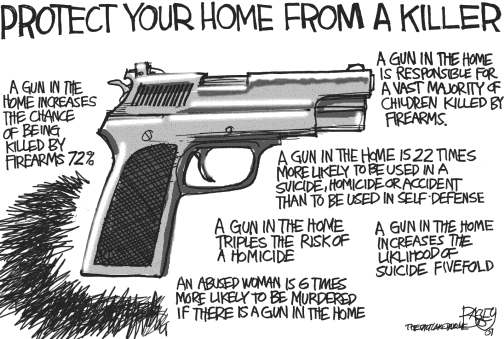
Sure, most adult non-felons have the right to own a firearm, but that doesn't mean it makes sense for them to do so. Though I and Ceasefire Oregon do not advocate for gun ownership for nearly any reason, we especially recommend that a home NOT have a gun in it if it meets one of the following criteria:
- if anyone in the household has a history of violence or felony conviction
- if there are children of any age in the home (even if the gun is stored locked and unloaded, children typically know combinations and where keys are kept -- The National Violent Injury Statistics System, p. 2).
- if anyone in the household is emotionally unstable, depressed, or has expressed thoughts of suicide (Keeping a firearm in the home increases the risk of suicide by a factor of 3 to 5 and increases the risk of suicide with a firearm by a factor of 17 (Kellermann, 1992, p. 467, p. Wiebe, p. 771).
- if your family has a history of problems with guns
Make your home a hard target. Burglers will more likely pass you up to find an easier home to break into. So what are some alternatives to owning a gun?
- Be aware. If you see something suspicious, react. Go inside. Lock the door. Call the police. Call your neighbors.
- Insure that all doors and windows have strong locks, and that you use them whenever possible. Be judicious about who has keys to your home.
- Purchase and use a home security system, and advertise the fact with exterior signs. These systems can be costly, but well worth the price.
- If a home security system is not within your budget, you can still purchase signs to fool would-be intruders. You can also install inexpensive magnet-alarms for windows and doors. Most burglars wouldn't know the difference.
- Get a dog and advertise the fact that you have it. If a dog is not a reasonable choice for your household, you can still put a used dog bowl and leash near your door, along with signs, to fool intruders.
- Know your neighbors, talk with them regularly, and keep an eye on each other's homes. Share phone numbers so you can call each other if there is anything suspicious. Notify them of your schedule, particularly if you are going away on vacation. Your neighbors and you don't have to be best buddies, but if you just introduce yourself and show you are more than just "that guy next to me" they'll be more likely to react if they see someone suspicious around your property.
- Remove privacy fences or large hedges that impede sight of your doors and windows from the road. We all like privacy, but it allows intruders to enter unseen.
- Install motion-sensing lights outside your home, back and front.
- Start or join a neighborhood watch program for your block, and be active in it.
- Many local police forces have programs where, if you request it, they will patrol your property more often while you are away on vacation, or will patrol more often if you have a reason to feel threatened.
Of course, if you disagree with my suggestion not to own a gun, you can still do all of these suggestions in addition to owning a gun, thus reducing the need to have to use it.
For more facts about the dangers of having a gun in your home, see this page of New Yorkers Against Gun violence, which cites studies for their statements:
Addendum (3/7/13): Some additional thoughts, posted at the National Crime Prevention Council site, as well as this poster.
Citations mentioned above:
Catalano, Shannon, “Victimization During Household Burglary,” Bureau of Justice Statistics Special Report, September 2010, NCJ 227379
Kellermann, Arthur L.MD, MPH, et al. “Suicide in the Home in Relation to Gun Ownership.” New England Journal of Medicine 327 (1992): 467-72.
Kellermann, Arthur L. MD., MPH, et al. “Gun Ownership As a Risk Factor for Homicide in the Home.” New England Journal of Medicine 329 (1993) 1084-1119
Kellermann, Arthur L.MD, MPH, et al. “Injuries and Deaths Due to Firearms in the Home.” Journal of Trauma, Injury, Infection, and Critical Care 45 (1998): 263-67
The National Violent Injury Statistics System. Youth Suicide: Findings from a pilot for the National Violent Death Reporting System. Boston: Harvard Injury Control Research Center: Harvard School of Public Health, 2009. http://www.sprc.org/library/YouthSuicideFactSheet.pdf. Originally accessed through Harvard School of Public Health: Means Matters. Source of Firearms in Youth Suicides. Boston: Harvard School of Public Health, 2009. http://www.hsph.harvard.edu/means-matter/means-matter/youth-access/index.html.
Wiebe, Douglas J. PhD. “Homicide and Suicide Risks Associated With Firearms in the Home: A National Case-Control Study.” Annals of Emergency Medicine 41 (2003): 771-82.

